CSU Partners with PhysTEC to Boost California Science Teacher Production
 |
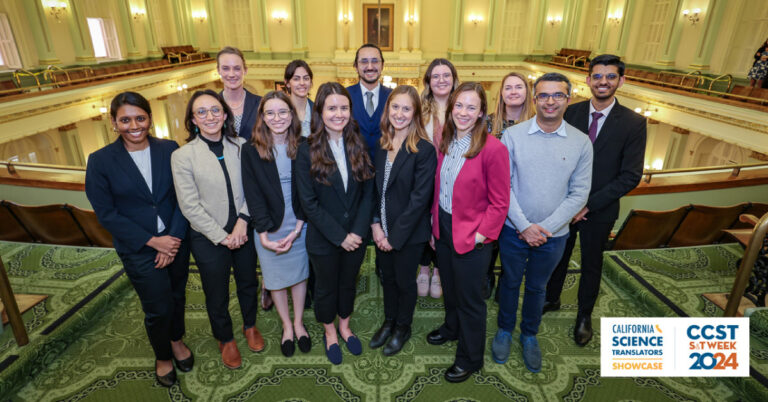
The PhysTEC Regional Conference of MSTI and CalTeach held in Ontario, California in February 2012
drew over 70 participants, with representation from 30
of 32 California campuses. Image courtesy of PhysTEC. |
California's perennial shortage of qualified science teachers is nothing new. Addressing the
shortage has long been a priority for the state, with both the University of California (UC) and
California State University (CSU) spending considerable resources in recent years to improve the
quality and quantity of credentialed science teachers. Despite these efforts, however, demand
continues to exceed supply of qualified science and math teachers; in California today, as many as
18% of high school physical science teachers lack appropriate credentials. It is to help address
this problem that the American Physical Society (APS) is proposing a systemwide partnership with CSU,
aimed at assisting the CSU in reaching its goal of producing 1,500 science teachers a year over the
next decade.
"Education and outreach is our future," said new APS President Robert Byer, a founding member of CCST and
CCST Council Chair Emeritus. "We need not only to continue our education efforts, but broaden them, increasing our
reach to help prepare teachers for teaching science at K through 12 levels through programs such as PhysTEC."
The Physics Teacher Education Coalition (PhysTEC), led by APS
together with the American Association of Physics Teachers (AAPT), is a project to improve and
promote the education of future physics teachers. To date, the project has funded 20 institutions as
Supported Sites to build model teacher preparation programs.
"PhysTEC has already provided support for programs at CSU Long Beach, Cal Poly San Luis Obispo, and CSU San
Marcos," said Theodore Hodapp, Director of Education and Diversity at the American Physical Society.
"CSU has a strong commitment to expand its science teacher production. Expanding PhysTEC to
a relationship that encompasses the entire CSU system should benefit all of us."
There are multiple components of PhysTEC implementation, but recruitment and outreach plays a significant
part of the program. PhysTEC works not only with the teacher preparation system, but with the physical
sciences departments as well.
"It's partly a question of changing attitudes," said Hodapp. "For many physics departments, the presumption is
that students are training for academic careers. We are working to make significant, lasting change in the culture of these
departments."
PhysTEC also works to strengthen the
curriculum to ensure that more teachers are confident in their knowledge of physical science, and incorporates
practicing teachers in residence into the teacher preparation and professional development programs. It also
focuses on working with campuses committed to the sustainability of the program, ensuring that the
changes brought about through the PhysTEC grants will have lasting effects on science teacher production.
The proposed partnership plays an important part in CSU's proposal to "100Kin10", a multi-partner organization
to meet the challenge posed by the National Academies "Rising Above the Gathering Storm", which identified
the nationwide shortage of science, technology, engineering and math (STEM) teachers as a critical
priority for the nation. The goal of 100Kin10 is to train 100 thousand teachers over the next ten years. The
organization is funded by a wide array of stakeholders, including the S.D. Bechtel Jr. Foundation, the
Bill & Melinda Gates Foundation, Google, and others.
PhysTEC's initiative has received an enthusiastic reception in the state. A meeting convened in February
2012 by PhysTEC for CSU and UC physics, chemistry, and teacher education faculty as a stand-alone
meeting before the annual PhysTEC conference drew over 70 participants, with representation from 30
of 32 California campuses. The meeting also helped PhysTEC engage in a three-way dialogue with the
UC Science & Mathematics Initiative (Calteach) and the CSU Math and Science
Teacher Initiative (MSTI).
"PhysTEC will make a key contribution to the CSU 100Kin10 commitment by addressing the severe
shortage of high school physics teachers in California, and the CSU system will help PhysTEC meet
its own 100Kin10 commitment to expand our model to an additional 50 institutions over the next 10
years, and to build the coalition to include over half of all physics departments."
CCST Spotlight is a weekly
newsletter focusing on CCST activities and highlighting innovative science
and technology research, applications, and policy issues in California.
The Spotlight editor is Danny DeCillis.
We welcome information and feedback from our readers about science and
technology at work in the private, public, and education
sectors.
To send us questions or comments, contact us at ccst@ccst.us, or (951) 682-8701.