News
Catch Up With CCST
Search our archives for CCST press releases, Spotlight newsletters, and original stories highlighting innovative research and initiatives at CCST Sustaining Institutions and Federal Affiliates. For general inquiries on CCST stories, contact Mikel Shybut. For media inquiries on CCST press releases, contact Keleigh Friedrich.
Get the latest on news, activities, and opportunities from our monthly CCST Spotlight Newsletter:
Other Information


Find Out What's New
- All
- Beyond California
- California Science News
- Calls for Expertise
- CalTAC
- Careers
- CCST Newsroom
- CCST S&T Policy Fellows
- CCST Science & Technology Week
- Closed Calls
- Events
- Expert Briefings
- Federal Research in California
- Obituaries
- Photo Gallery
- Press Releases
- Uncategorized
Update: Applications for the CCST Science & Technology Policy Fellowship Have Closed
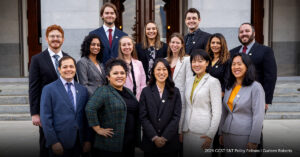
CCST Science & Technology Policy Fellowship Placing PhD Scientists into Policy Careers Update (3/12/2024): The application for…
Toward Science (and Science Policy) without Walls
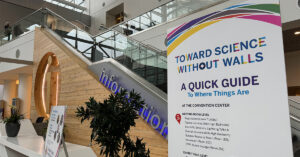
It’s the Journey, Not the Destination It’s time for the walls that separate scientists from each other…
Development Manager
The California Council on Science and Technology seeks a Development Manager to strategically formulate and execute plans…
Recap: CCST Science & Technology Week 2024
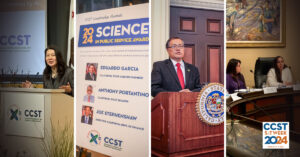
Leveraging Artificial Intelligence for a Resilient California Our kickoff “Blue Sky” panel brought together a diverse group…
GALLERY: S&T Week 2024 Reception and Leadership Awards
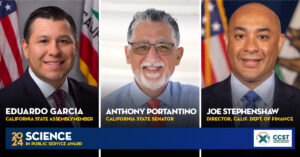
The awardees were recognized at CCST’s S&T Week Reception and Leadership Awards Ceremony by members of CCST’s…
GALLERY: CCST’s California Science Translators Showcase Returned to S&T Week 2024
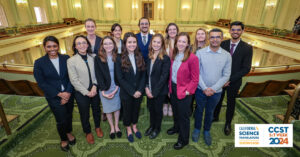
The California Council on Science and Technology (CCST) was excited to host the 2024 CCST Science Translators…
Watch: Pathways for a More Smoke-Resilient California
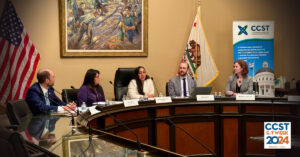
California’s future is expected to be more smoky as wildland fires become more common. Beneficial wildland fires…
Watch: Leveraging Artificial Intelligence for a Resilient California
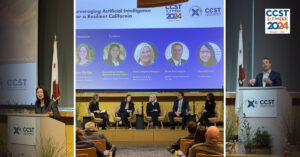
Serving as the kickoff event to CCST Science and Technology Week 2024, this “Blue Sky” panel brings…
Innovation and Strategy Executive Louis Stewart Appointed to CCST Board of Directors

Appointed as an Independent Director, Louis brings experience in the public and private sectors, innovation, business diversity,…
Watch: All About the CCST Science & Technology Policy Fellowship
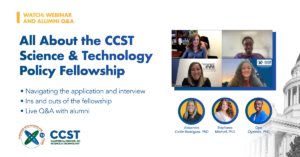
WATCH All About the CCST Science & Technology Policy Fellowship Informational Webinar and Live Q&A with…
In-Person: Key Challenges for California’s Energy Future
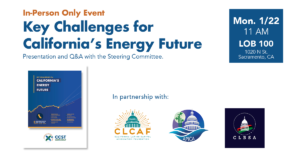
MON. JAN. 22 | 11AM PT | LOB 100 Key Challenges for California’s Energy Future Presentation and…
Introducing the 2024 CCST Science & Technology Policy Fellows
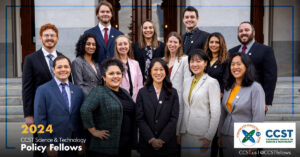
MEET THE NEW FELLOWS Introducing the 2024 CCST Science & Technology Policy Fellows See where these talented…
Bruce Darling (National Academy of Sciences) and Charles Harper (Jariet Technologies) Retire from CCST Board of Directors

Bruce Darling and Charles Harper, MBA, are retiring from the Board of Directors of the California Council…
Highlights from CCST’s 35th Year + 2024 Preview

In 2023, CCST celebrated 35 years of strengthening California policy with science. Along the way, we significantly…
Executive Summary: Search for the Chief Executive Officer
The California Council on Science & Technology seeks a dynamic and visionary Chief Executive Officer to lead…
Watch: Lithium Extraction from Geothermal Brine
Lithium Extraction from Geothermal Brine Lithium is a key component of rechargeable lithium-ion batteries and is considered…
Watch: Lithium Supply Chains – Charging Our Future with Sustainable Sources
Lithium Supply Chains: Charging Our Future with Sustainable Sources The degree to which the U.S. lithium battery…
How Extracurriculars Shaped my Policy Career – ’23 Fellow Stephanie Mitchell, PhD

There are many ways that being a scientist can help prepare someone to work in a…
Update: Application closed – Calling California Grad Students and Postdocs: Apply for CCST’s Science Translators Showcase
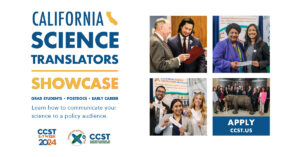
Update (11/13/2023): The application for the 2024 CCST Science Translators Showcase is now closed. Please join us…
Finance and Strategy Executive Jeffrey Scott Appointed to CCST Board of Directors

Appointed as an Independent Director, Jeff brings experience in the government, private sector, consulting, and academia SACRAMENTO,…
The Room Where it Happens: Q&A with ‘23 Fellow Jeanmarie Gonzalez, PhD
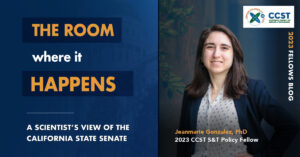
Where are you placed? I’m working in the office of Senator Maria Elena Durazo, who represents…
Our Mission
To engage leading experts in science and technology to advise State policymakers - ensuring that California policy is strengthened and informed by scientific knowledge, research, and innovation.